As I write this article, I know that my ideas, my words, and my thoughts will most likely be taken without my consent and used to train large language models (LLMs) that will feed generative AI models. I know that no matter what I say about the impacts of AI on education, publishing, creative arts, critical thinking, and the environment, many people will simply say: “AI is already here, you need to accept it and adapt.” But hope is a flower that can still bloom, even in the darkest places.
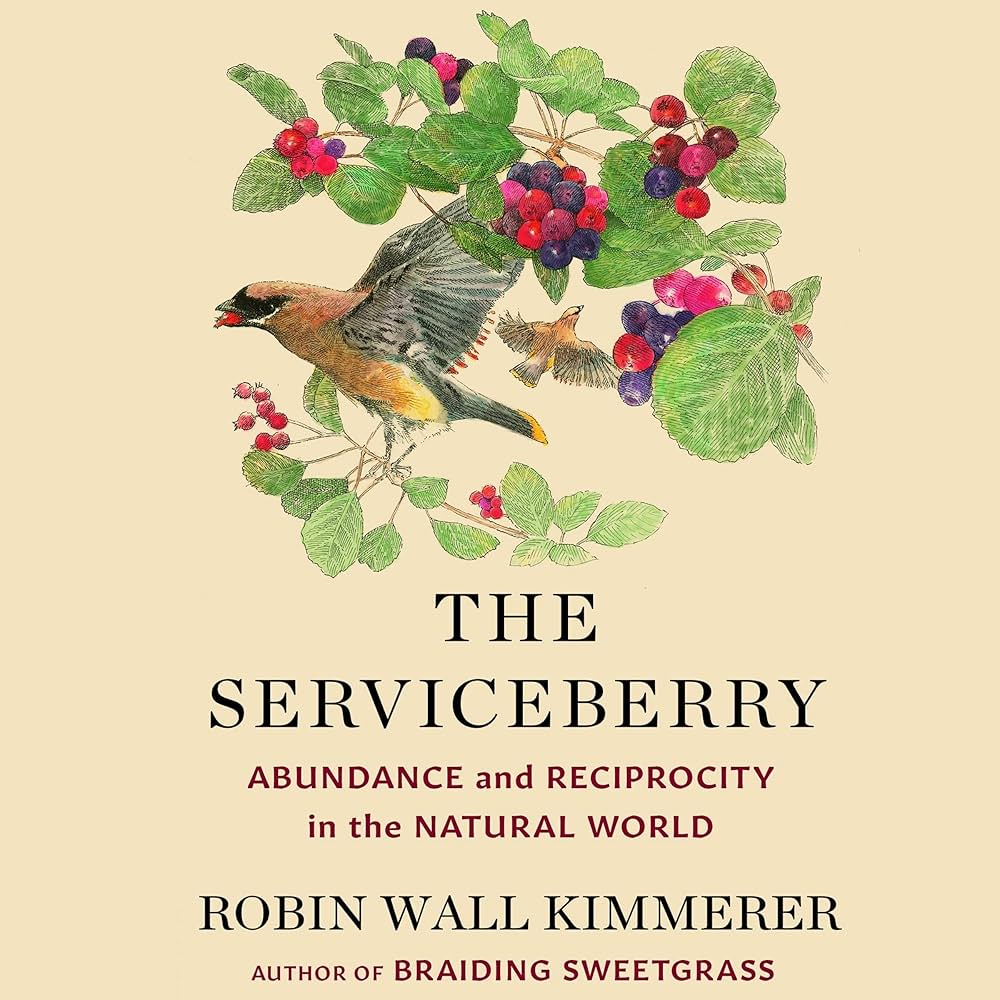
I have read all of Robin Wall Kimmerer’s books. She is a generous scholar, sharing her knowledge of Potawatami culture, beliefs, and practices and combining that with her background in biology. Her most recent book, The Serviceberry: Abundance and Reciprocity in the Natural World, is short at just over one hundred pages, and just like a serviceberry, this book is packed with nutrients for the mind and body.
Wall Kimmerer explores the notion of a gift economy by asking questions about what it could be like in contemporary North America, as well as the world over. The gift economy grates against capitalist market models, because gifts and the exchange of them create conversations outside of economic and monetary transfer. When you drive a friend to the airport (the gift of transport), or feed someone’s cat when they are sick (the gift of food and care), or take a lasagna to a friend who just had a baby (gift of food), you don’t just exchange something. You build community and create stories that exist long after the gift is gone. When you buy something in a market model, there is “strictly [a] material transaction” (p21, Serviceberry). Wall Kimmerer uses the example of buying something at a supermarket, and trying to stay on to have a chat with the cashier. It would look strange, feel strange, and the cashier would probably be confused, as would the people around you. That is the capitalist market.
She defines the gift economy as, “wealth is understood as having enough to share, and the practice for dealing with abundance is to give it away. In fact, status is not determined by how much one accumulates, but by how much one gives away. The currency in a gift economy is relationship, which is expressed in gratitude, as interdependence and the ongoing cycles of reciprocity” (p32-33, Serviceberry).
The capitalist model, and in general most Western models of economics and the market, are built on a scarcity mindset. As Wall Kimmerer points out, “one of the assumptions of modern economic theory is that we will each behave in conformity to Adam Smith’s ‘Rational Economic Man’, characterized as a greedy, isolated individual acting purely in self-interest to maximize return on investment. The system is designed to support this hypothetical caricature and seems therefore to produce them” (p44-45, Serviceberry). To quote Mark O’Connell, “the way we build our gods […] is the way we build the apocalypse” (p159, Notes From An Apocalypse). We see this in the proliferation of the class divide. One such example is people buying more and more houses to supplement their ‘passive incomes’, while others cannot afford to buy homes themselves, and many others are left in precarious living situations or are unhoused. I find it strange, almost comical at this point, that after bloody revolutions that overthrew monarchies and the bourgeoisie, we are right back to where we started. Perhaps we never really moved away from it? And how can we move away from it in capitalism?
So how can gift economies exist in this kind of economic model? Somehow, they still do – people find a way. Wall Kimmerer uses examples such as people producing fruit and vegetables, gifting their excess harvest. I see this in my local streets in winter when people with lemon trees put buckets and baskets out with little signs saying “Free Lemons”. Another example of the gift economy is Little Free Libraries, which have popped up all over the world. There are a few around my neighbourhood and I regularly leave books there for others to enjoy. I also love to walk past and check if there is something special for me. The other example that Wall Kimmerer writes about is the gift economy in online spaces – YouTube, TikTok, blogs, etc. There are so many people online sharing their knowledge. If you’ve made it this far, you might have figured out that what I am writing right now is an example of the gift economy.
These online or digital gifts are what I want to really talk about today. There are many examples of them, and in many ways, the internet has given us a wealth of knowledge we never had before. And yet, there has been a perversion of the gift.
Accompanying the scarcity model is a concept known as ‘game theory‘. The main idea behind it is that it studies “interactive decision-making, where the outcome for each participant or “player” depends on the actions of all” (PBS). It is a theory used across many different disciplines, and each discipline will have its own applications and ideas. I want to talk about this in relation to the rational economic man. The rational economic man is often used as a model for understanding individual actions in game theory – especially when one of the notions of game theory is that individuals want to maximise profits and minimise losses. Conversely, another assumption of game theory is that everyone (the players) will act reasonably. Now, how one defines reasonable behaviour and maximising profits is a longer ethical, moral, and philosophical discussion. Game theory itself is not inherently good or bad. It is a tool that allows us to understand and measure human interactions.
Now, here is where AI companies and the digital gift economy collide. A digital market and a digital gift economy have grown together since the birth of the internet. Like any other gift economy, it too has grated against capitalist models. People gift ideas, art, videos, life hacks, and jokes. People also monetise these things to varying degrees. Game theory allows us to look at how this has played out. And in real-time, we can observe a small number of people who are extremely financially and politically powerful, taking advantage of both the market and the gift economy online. Have you ever been in a group assignment and been the only one to put in any effort, but then realised that all your colleagues who did nothing will end up with the same grade as you? Using game theory to understand that, we can see that the individual motivations were indeed about maximising profits; however, how these profits, AKA getting good grades, were maximised had completely different approaches.
We can see that, just like the group assignment example from above, the same could also apply to tech companies and the general population. Everyone is trying to maximise profit – the approach and outcomes are another story.
I have always wondered why tech companies would come after the arts, writers, poets, and painters? I think back to the pandemic days, and what everyone turned to – movies, T.V. shows, drawing, music, making, cooking, gardening… They turned to the arts in a time of crisis. I might be biased, but I think that what we write, make, sing, play, draw, and paint are some of the main reasons life is worth living. And tech companies want to not only pervert this practice, but also take control of it.
To return to the wise words of Wall Kimmerer, “Let’s remember that the ‘system’ is led by individuals, by a relatively small number of people, who have names, with more money than God and certainly less compassion” (p71 Serviceberry). She writes about the Potawatami monster, the Windigo – “it suffers from the illness of taking too much and sharing too little” (p81 Serviceberry). I wonder if it is even more than that. Could it go beyond this desire to consume and to have everything, and to also encompass consuming the talents of others that you do not possess? I think of generative AI models as the digital manifestation of the Windigo. And I fear that more might follow.
I have no real optimism in the face of what is to come. So I will simply leave you with these parting words from Shannon Vallor, inspiring AI ethics professor and author of The AI Mirror, who writes: “our dominant values favor those who don’t get writer’s block, who don’t struggle to find the right words, or images, or notes, or movements, who never get caught up in the swirling drag of inexpressible meanings. Our economic order has long rewarded creators who work like machines. Should we really be surprised that we finally just cut out the middle-man and built creative machines” (p142).
As always, share the reading love.

 bound2books