
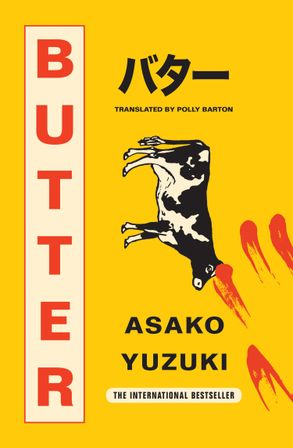
At the recent Melbourne Writers’ Festival, some great authors from around the globe visited to discuss all things books. I was so glad I could get a ticket to Asako Yuzuki’s sold-out talk on her extremely successful novel Butter. It was amazing to hear her talk about her novel and her writing process, and, surprisingly to me, how her novel received lukewarm responses in her home country, Japan. Not long after it came out in Australia, Butter was hard to keep on the shelves. Tall, teetering stacks of the novel would promptly appear in bookstores, only to be emptied a few hours later.

Something in Butter spoke to readers from all over the globe, not just Australians. Yet, back in Japan, Yuzuki talks of her book being critiqued for being too harsh, too feminist, and too indulgent. And honestly, what is more decadent than thick, creamy, salty butter?
For those who haven’t read the novel, Butter is a deliciously complicated novel based on the real-life 2012 “Konkatsu Killer” case – where a woman was convicted of murdering three male lovers by poisoning them with food. Women as murderers have always captivated readers and news outlets. I half-wonder if this is because it is such a rare thing. Men killing women at alarming rates around the globe is hardly news when it happens so often?
Australia is in the grips of its own poisoning saga, with a woman currently on trial for allegedly killing people with poisonous mushrooms. The case, known locally as the “Mushroom Killer”, has the same short, catchy title as Japan’s 2012 case. The woman allegedly cooked a meal of beef Wellington with death cap mushrooms.
The Konkatsu killer is an interesting case, and it is not surprising that Yuzuki wanted to explore this story and its broader social and cultural implications in her novel. The term Konkatsu refers to a woman who is actively seeking a husband and refers to the practice of ‘marriage hunting’. There are many reasons for this term emerging from the early 2000s. It coincides with Japan’s declining birth rates and the need to repopulate the country. It also exposes the paradox for women because on the one hand, they are demeaned for seeking partners and are nothing more than marriage hunters. On the other hand, they are told that their only role in society is to be a wife and mother.
Yuzuki plays with this paradox throughout her novel, and she never gives a straight answer to any of the themes she explores. The novel’s conclusions are complicated yet simple, just like cooking.
Junko Takase’s novel, May You Have Delicious Meals, was published in Japanese in 2022 and won the prestigious Akutagawa Prize that year. It was later translated and published in English in early 2025. Butter would take almost seven years before it was translated into English in 2024. A fun fact from the interview at the writers’ festival: Yuzuki had said her publishers did a Google Translate of the first few chapters without even putting much effort into selling it to an international publisher. Gosh, did they get that wrong!
I find it so strange that two books, both by Japanese women, both discussing themes of societal and cultural pressures around femininity, work (domestic and paid), and food, would have such wildly different receptions.
May You Have Delicious Meals is set in a workplace and follows the dynamics of the people in the office. The novel explores the idea of “doing what is right” and people’s regrets and resentments around it.
But then whenever he worked with someone who had studied literature he would lose his shit, thinking: I chose economics because I thought it’d help me get a job, but then I keep running into people who did literature, the same age as me, or older or younger. When I chose what to do at uni when I was a teenager, I chose an easier life over what I actually wanted, he had thought over and over, though it was an exaggeration.
May You Have Delicious Meals p. 56
Takase talks about “the rules of politeness for eating homemade treats”, but these rules are more like metaphors for how one should be and act in society. One must carve oneself into palatable pieces to be consumed by the culture. Much like Yuzuki, the two authors explore the overwhelming pressure to fit in, to sublimate one’s own desires to be considered ‘good’, ‘valued’, and ‘acceptable’. These words hold different weights for men and women, and both authors challenge these in thought-provoking ways throughout their respective works.
So why is Takase’s work an award-winning novel in Japan and Yuzuki’s not? I don’t think pitting the two novels against each other or the writers is fair. But I would guess that many of the differences in reception of the two novels come down to some of these cultural norms and how they are challenged in each book. Moreover, each novel tackles concepts like feminism, autonomy, lust, and desire. And lust and desire for not just rich foods, but lust and desire for life, freedom, pursuing dreams, and feeling alive. How specific readerships take on and interpret those is a different story.
In saying all of this, I thoroughly recommend both novels. One is more novella-sized and the other, much more meaty. Both pack a punch, and I still find myself thinking about them regularly, which, in my opinion, is the point of good literature. As always, share the reading love.

 bound2books
Pingback: A 2025 Summer Reading List (Generated by a Human) | bound2books